Forty Characters of Comfort: The Quiet Revival of British Teletext Art
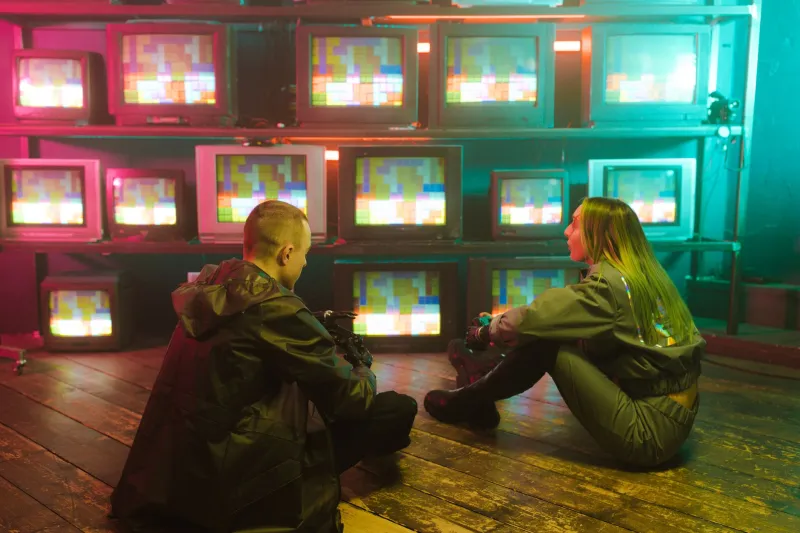
Somewhere in a spare room in Sheffield, a Raspberry Pi is broadcasting a weather map for a town that no longer has a weather map. It’s not on the internet, not on an app, not even on a screen you’d recognise as modern. It’s on a television, via a scart lead, in 40 characters by 24 rows, in eight colours and a font that looks like it was designed by a committee of librarians. And someone, somewhere, is delighted by it.
This is the quiet corner of British web culture where teletext never really died. It just went underground, into galleries, into Pi-powered micro-services, into the hands of people who can make a mosaic out of a semicolon and a bad attitude. The scene is small, stubborn and oddly warm. It’s also having a moment — again — in 2026.
The 40-Character Hug
If you grew up with Ceefax, you’ll know the feeling. Page 302 for football, 401 for the lottery, 888 for subtitles. The screen was clunky, the loading times were glacial, and the whole thing felt like it was being typed out by a man in a shed in Salford. But it was also intimate. Forty characters is roughly the length of a text message from your mum. It forces brevity. It forces charm.
Teletext art takes that constraint and treats it like a canvas. Artists work in block graphics, mosaic characters, double-height text and a palette that can only be described as “early 1980s airport departure board”. The results can be funny, eerie, political or just plain weird. A page might show a pixelated cat, a brutalist tower block, a poem about a bus timetable, or a fake news headline from a country that doesn’t exist. The best pages feel like found objects from a parallel Britain.
From Ceefax to Gallery Walls
Ceefax launched in 1974 and was switched off in 2012, which means an entire generation has grown up without it. But the art form didn’t vanish. It migrated. The International Teletext Art Festival has been running for years, showing work on actual televisions and online. Galleries in London, Berlin and beyond have hung screens showing pages that were never meant to be hung. There’s a lovely tension in that: a medium built for utility, for football scores and flight delays, now being framed and lit like a painting.
The artists themselves are a mixed bunch. Some are coders who grew up reverse-engineering teletext decoders. Some are graphic designers who like the discipline of a fixed grid. Some are archivists, quietly rebuilding lost pages from screenshots and memory. One artist, who posts as @blocky_marrow, describes it as “like writing a haiku with a brick”. Another runs a service from a cupboard in Norfolk that broadcasts local news for a village of 400 people. It has three readers. They love it.
Pirate Signals and Pi Servers
A lot of the scene runs on Raspberry Pis, old DVB cards and a certain amount of wilful improvisation. The Teefax project, for example, turned a Pi into a teletext service you can pipe into a telly. Others have built their own low-power transmitters, or piggybacked on digital radio, or simply run a web emulator that looks like a Teletext TV. The term “pirate” gets used loosely — most of it is legal, some of it is grey, all of it is done for the love of a screen that beeps when you press the wrong button.
What’s striking is how local it all is. The internet made everything global, but teletext art made it parochial again. People make pages for their own towns, their own bus routes, their own chip shops. There’s a page for a lost department store in Leeds. There’s a page for a pub quiz that stopped running in 2019. There’s a page for a cat called Dennis. It’s the same impulse that drives local messageboards and hyper-local legends: the desire to make a small place feel big enough to be worth recording.
Why Now?
In 2026, we are surrounded by interfaces that are smooth, fast and utterly frictionless. Teletext is the opposite. It’s slow. It’s ugly. It’s limited. And that’s exactly why people like it. It feels like a holiday from the algorithm. You can’t doomscroll a teletext page. You can’t get a notification. You can’t even get a decent photograph. You just get a blocky little world that takes its time.
There’s also something very British about the whole thing. We have a long history of loving obsolete interfaces — the cassette, the BBC Micro, the answerphone tape, the railway departure board that clacks rather than scrolls. Teletext sits in that tradition. It’s the digital equivalent of a seaside pier: slightly faded, a bit wonky, but comforting in a way that a shiny new app never quite manages.
The scene is still tiny. It’s still mostly blokes in spare rooms, though that’s slowly changing. It’s still more likely to be shown in a gallery in Margate than to trend on TikTok. But it’s growing. New services are launching. New artists are picking up the grid. And somewhere, on a television in a spare room in Sheffield, a weather map is being broadcast to nobody in particular. That, somehow, feels like the whole point.
You can find teletext art on emulators, on Pi-powered services, and in the occasional gallery show. Start with page 888. It’s subtitles, usually. But in this world, it’s also a door.