The Bench, the Bin and the Beloved Roundabout: Britain's Unlikely Google Maps Celebrities
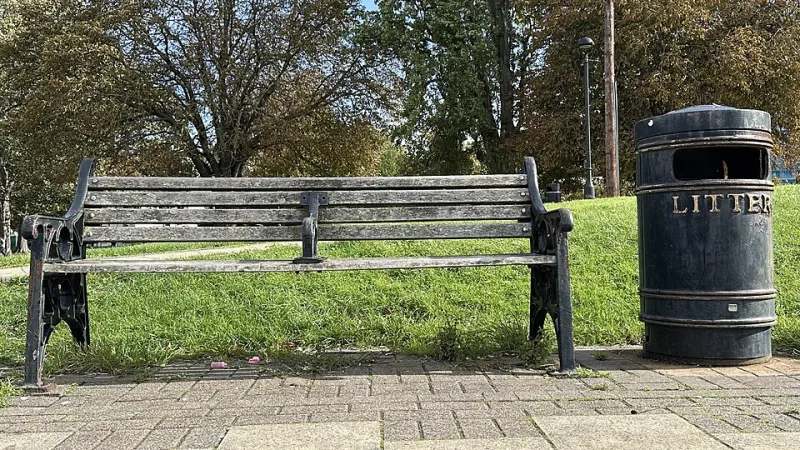
Photo: OathOn, CC BY-SA 4.0, via Wikimedia Commons
There is a bench in Sheffield that has never had a famous bottom on it. It sits near a bus stop, faces a patch of grass, and does exactly what a bench is supposed to do. And yet, on Google Maps, it has a small but devoted following. One reviewer calls it 'a reliable friend in a city that never stops moving'. Another notes that the view is 'mostly traffic, but in a comforting way'. A third gives it five stars and writes, simply: 'Good bench.'
This is not an isolated case. Across Britain, Google Maps has become an unlikely stage for a very specific kind of local celebrity: the ordinary street object with an extraordinary review section. We are talking benches, postboxes, roundabouts, puddles, car parks, bus shelters and the occasional bin. Places that were never meant to be destinations are being written up with the earnestness of a restaurant critic and the deadpan humour of a local messageboard. And in the process, they are turning into something else entirely: hyper-local inside jokes, accidental social history and tiny acts of civic pride.
The art of the unnecessary review
You know the type. You are looking up a chip shop, or checking whether a car park has a height restriction, and you fall down a rabbit hole. Suddenly you are reading a 300-word meditation on a bench. It is not a review in any practical sense. Nobody is choosing a bench based on its Tripadvisor rating. But that is precisely the point. The review is not there to help you decide. It is there to say: I was here. I noticed this. It mattered, briefly.
The best of these write-ups have a distinctly British tone. They are self-deprecating, quietly observant and allergic to earnestness. A puddle in Cardiff is described as 'a moody little mirror that only appears after heavy rain'. A roundabout in Milton Keynes is praised for 'keeping things moving, emotionally as well as physically'. A car park in Brighton gets a five-star review because 'it smells of chips and possibility'. These are not jokes for the sake of jokes. They are small, shareable moments of recognition.
A puddle with a personality
The puddle is perhaps the purest example of the form. It is temporary. It is inconvenient. It is, by any reasonable measure, nothing. And yet, a well-reviewed puddle can become a local landmark. People check on it after storms. They note its size, its reflectiveness, its tendency to reappear outside the same kebab shop every autumn. One reviewer in Leeds wrote: 'Not the biggest puddle, but it commits.' Another in Glasgow added: 'Saw a pigeon use it as a bidet. Five stars.'
This is where the reviews start to feel like something more than whimsy. They are a record of the places we actually inhabit - the routes we walk, the corners we wait on, the bits of pavement we know intimately but never think to describe. When a puddle gets a review section, it becomes part of the map in a way that a puddle normally is not. It becomes a shared reference point. 'Meet you by the puddle' is a sentence that only makes sense if you live there.
Civic pride, one star at a time
There is a fine line between taking the piss and taking pride. The best Google Maps reviewers walk it expertly. A five-star review of a postbox is not really about the postbox. It is about the fact that someone noticed it. That someone took the time to say: this red cylinder is part of the furniture of our lives, and it is doing a good job.
In the Highlands, a remote postbox has reviews praising its 'stoic silence' and 'reliable commitment to the cause'. In a suburb of Manchester, a bus shelter is celebrated for its 'wind-blocking capabilities' and 'excellent people-watching'. In Norfolk, a bench overlooking a field gets a review that reads, in full: 'Sat here. Ate a sausage roll. Felt alright.' It has 47 helpful votes.
These are tiny acts of civic pride. They are also a way of pushing back against the idea that only grand things are worth writing about. Britain is full of ordinary places that never make it into guidebooks. Google Maps gives them a page. The reviewers give them a voice.
Accidental social history
Scroll through enough of these reviews and you start to notice something else: they are a record of change. A bench that has been removed gets a wistful update. A car park that has been redeveloped gets a final review. A puddle that has been paved over gets a eulogy. 'RIP to a real one,' someone writes. 'You reflected the sky better than anyone.'
This is not formal history. It is not curated by archivists or funded by heritage bodies. But it is a kind of archive all the same - a crowdsourced, slightly chaotic, very British account of what was there and what it meant to the people who passed it every day. In fifty years, these reviews might be the only evidence that a particular bench existed, that a particular puddle formed, that a particular roundabout was, for a while, the centre of a very small universe.
A curated tour of Britain's most reviewed nothing
If you want to go looking, you do not need a guidebook. You need a free afternoon and a willingness to follow the weird little rabbit holes of Google Maps. Start with the bench near the bus stop in Sheffield. Then find the puddle in Cardiff. Then the roundabout in Milton Keynes. Then the car park in Brighton. Then the postbox in the Highlands. Each one has its own small mythology. Each one has been written into existence by someone who stopped, looked and decided to leave a review.
You will not learn anything useful. You will not find a hidden gem in the traditional sense. But you will find something else: a reminder that the places we share are made of small things. A bench. A bin. A puddle. A postbox. And that noticing them - really noticing them - is its own kind of entertainment.
Why we cannot stop scrolling
So why do we do it? Why do we read these reviews? Why do we write them? Part of it is the comedy. The absurdity of reviewing a puddle is funny, and the deadpan British delivery makes it funnier. Part of it is the local pride. It is nice to see your corner of the world get a little attention, even if the attention is for a particularly good bench. And part of it is something simpler: the pleasure of a shared joke with strangers.
At Sirvez, we spend a lot of time looking at the internet's quieter corners. The Google Maps review section for a bench is one of those corners. It is not trending. It is not monetised. It is just there, waiting for someone to scroll past and think: 'Hang on, that bench has 23 reviews?' And then, before you know it, you are reading all of them.
Next time you pass a bench, a postbox or a puddle, take a second look. Someone might be writing a five-star review about it right now. And honestly? They might be onto something.