On Hold, Off the Grid: The Tiny Soundtracks Britain’s Small Businesses Commission Themselves
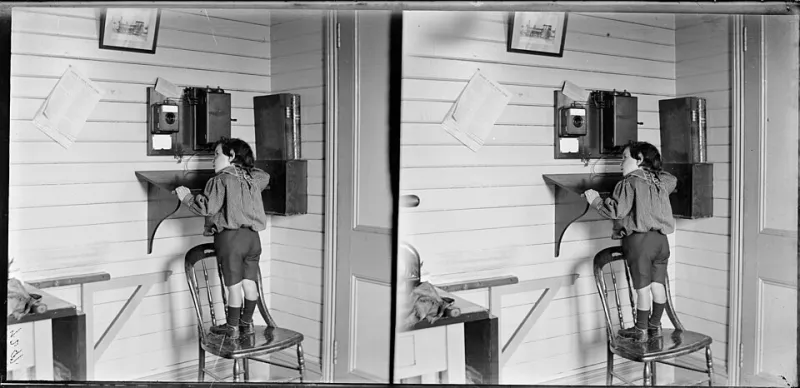
Photo: National Library NZ on The Commons, No restrictions, via Wikimedia Commons
Call a garage-door repair firm on the edge of Norwich and you will not get silence. You get seventeen seconds of synth brass, a drum machine that sounds like it is thinking about a different job, and then a click. A voice says: ‘Sorry, love, we’re on another call.’ The loop starts again. It is not slick. It is not licensed from a moody playlist. It was almost certainly made by a man called Dev in a spare room in Bristol, and it is one of the most comforting sounds in British service culture.
Welcome to the bespoke hold-music underground: the small businesses who commission their own telephone soundtracks, and the composers, engineers and shop owners keeping the form alive. In 2026, when every brand has a sonic identity and every app has a hold screen, the real oddity is the landline loop — tinny, repetitive, and accidentally perfect.
The four-bar commission
Most of this music is born from a very practical problem. A business buys a phone system. The phone system comes with default hold music. The default hold music sounds like a lift in a business park. Someone says: can we get something else? And so begins a chain of WhatsApp messages that ends with a WAV file and a small invoice.
Mara, a composer in Leeds, has made around thirty of these loops. She works from a home setup with a second-hand Yamaha keyboard and a microphone she bought during a brief podcast phase. ‘People do not want a song,’ she says. ‘They want a feeling that lasts about forty seconds without becoming annoying. That is a strange brief. You have to write something that can survive being heard two hundred times in one afternoon.’
Her clients have included a chip shop in Whitley Bay, a dental surgery in Solihull and a mobile dog-grooming van in Cardiff. The chip shop wanted jazz. The dentist wanted ‘something calm but not sleepy’. The dog groomer wanted ‘like a spa, but for dogs’. Mara delivered all three. None of the tracks are online. They exist only on a phone system, in a back office, waiting.
A very British kind of broadcast
Hold music is one of the last places where local taste is broadcast without a content strategy. A corporate playlist is chosen by a committee. A hold loop is chosen by the person who answers the phone. That person might love smooth saxophone. They might have a soft spot for 1990s trance. They might insist on a pan flute version of a Beatles song because it reminds them of a holiday in Tenby. The result is a tiny, unguarded portrait of a business.
Dev, a sound engineer in Bristol, describes the genre as ‘functional nostalgia’. He has recorded loops for a locksmith, a funeral director and a garage-door company. ‘The garage-door one is the one people ask about,’ he says. ‘It is just a bassline and a synth pad. It sounds like the beginning of a crime drama. But the owner loved it. He said it made the firm sound bigger than it is.’
That is the thing about hold music: it is aspirational and homemade at the same time. It wants to be professional. It wants to say: we are a real business, we have a phone system, we are handling it. But it also sounds like a mate’s keyboard demo. The gap between those two things is where the charm lives.
The accidental archive
No one is archiving this stuff. That is what makes it interesting. The loops sit on old hard drives, on phone-system servers, on USB sticks in drawers. When a business closes, the music usually goes with it. When a phone system is upgraded, the loop is often overwritten without a second thought. We are losing a whole category of local sound — not because anyone decided it was worthless, but because nobody decided it was worth keeping.
This is where the Sirvez instinct kicks in. The best discoveries are rarely in the obvious places. They are in the waiting room, the queue, the ‘please hold’ that nobody listens to on purpose. A hold loop is a tiny folk artefact: composed for a specific shop, played to a specific town, forgotten by everyone except the people who call that shop often enough to know the melody.
There are exceptions. A few composers now keep their own archives, partly out of pride and partly because clients occasionally ask for ‘the old one’ back. One engineer in Glasgow has a folder called HOLD MUSIC 2010–2026, which is exactly the kind of accidental museum we deserve. It contains a bossa nova loop for a hairdresser, a steel-drum number for a car wash and a piece of music described in the file name as ‘plinky but serious’.
Why the loop still matters
In an age of frictionless apps and silent chatbots, a hold loop is a small act of human stubbornness. It says: someone is coming back to the phone. Someone made this. Someone chose it. It is not personalised in the data sense. It is personalised in the sense that a person, probably while eating lunch at their desk, decided that the bossa nova was too much and the pan flute was too little.
So next time you are on hold, listen properly. Clock the drum machine. Notice the moment the loop restarts. Wonder who made it, and why. The bespoke hold-music underground does not have a scene, a label or a mailing list. It has a phone number, a waiting customer and a four-bar loop that will never trend. That is precisely why it feels like a find.