Under the Table: The Volunteers Mapping Wetherspoons Carpets Like Folk Art
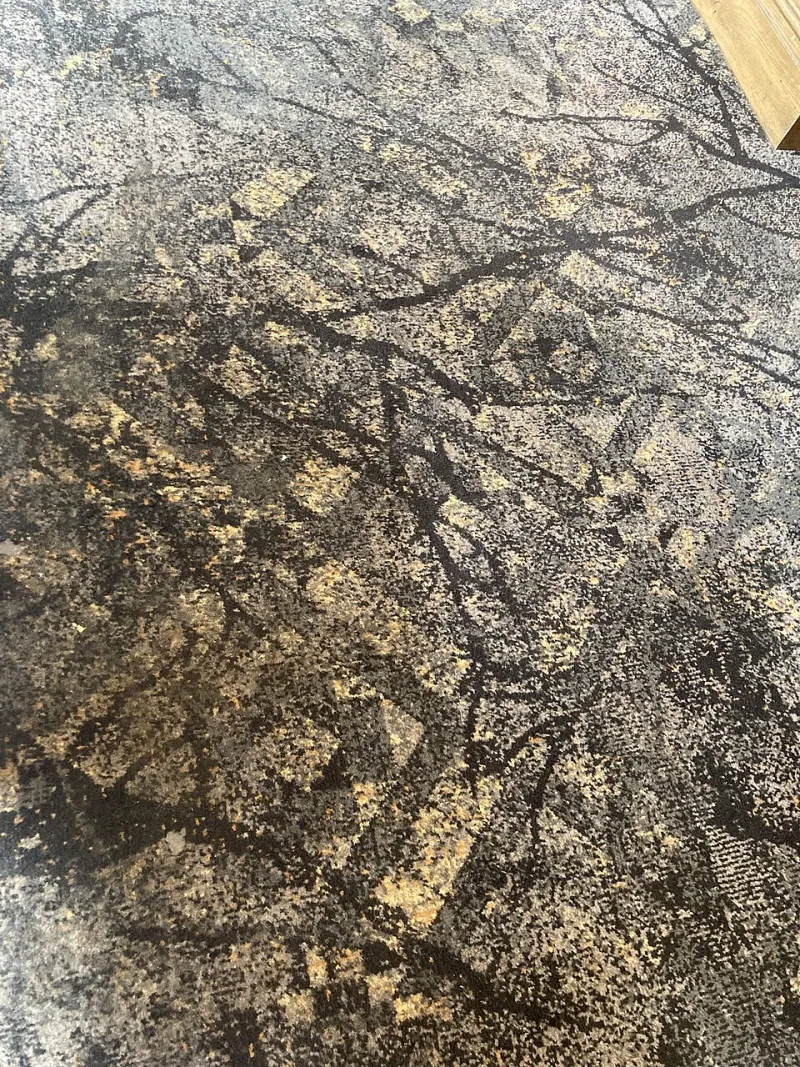
Photo: Ser!, CC BY-SA 4.0, via Wikimedia Commons
On a wet Tuesday in Leeds, Hannah is on her hands and knees in a Wetherspoons, photographing a carpet. She is not looking for dropped change. She is trying to capture the exact shade of burgundy under the table legs, the bit where the pattern repeats, and the small wine stain that makes this particular square of nylon unique.
Hannah, 31, is one of a loose network of volunteers who catalogue Wetherspoons carpets. They work across shared spreadsheets, Flickr pools and Discord servers, logging pub names, towns, patterns, dates and notes. Some call themselves carpet archivists. Others prefer carpet spotters. No one is paid. No one has been asked to do it by head office. The chain has never, as far as anyone can tell, published a carpet catalogue.
That is the strange appeal. Britain is full of unofficial archives of things nobody thought to preserve. This one just happens to be under a pint.
The carpet is the clue
Wetherspoons carpets have been a joke for years. They are loud, geometric, occasionally psychedelic, and weirdly consistent. A carpet can say 'you are in a Spoons' before you have seen the menu or the clock. But the joke has a second life. Once you start looking, the carpets become clues: to refurbs, to regional quirks, to the chain's long, slow visual evolution.
'It started as a bit,' Hannah says. 'I took a photo of a carpet because it looked like a bowling alley had exploded. Then I noticed the next Spoons had a different one. Then I wanted to know how many there were.'
The archive is not exhaustive. It is not official. It is held together by people who are willing to crouch by a table and take a photo while a stranger eats a mixed grill. The rules are informal: ask staff if you can, avoid faces, don't make a scene, don't be weird about it. The best shots are flat, clear and taken without a flash. The worst are blurry, sticky and smell faintly of chips.
A spreadsheet with a beer problem
At the centre of the project is a shared spreadsheet. Columns include pub name, town, county, postcode, pattern name, date photographed, and a notes field for anything odd. Pattern names are not official. They are descriptive, argumentative and occasionally poetic. 'Blue rhombus with red squiggle' is a real entry. So is 'the one that looks like a carpet from a 1990s hotel lobby'.
Volunteers disagree about how to classify. Is a carpet with a subtle change a new pattern? Does a refurbished pub count as a new record? What if the carpet is the same but the lighting makes it look different? The spreadsheet has become a low-stakes exercise in taxonomy, which is either very British or very internet, depending on your mood.
'It's not about interior design,' Hannah says. 'It's about noticing. Most people look at the table, the pint, the phone. The carpet is the thing underneath all that. It's the bit everyone walks on and no one looks at.'
Why the chain pub?
Wetherspoons is a useful subject because it is everywhere. There are branches in train stations, seaside towns, old cinemas and shopping centres. The carpet travels. It is one of the few things that can be both brand identity and accidental folk art. A Spoons carpet is not a masterpiece. It is a surface designed to hide stains and survive spilled lager. But that is part of its charm. It is a pattern made for real life.
The archive also captures change. Pubs get refurbished. Carpets get ripped up. A photograph from a few years ago might be the only record of a pattern that no longer exists. The volunteers are not saving the carpet itself. They are saving the look of it, the fact of it, the small evidence that a particular room once had a particular floor.
Folk art or wayfinding?
Both, probably. For designers, the carpets are a study in repetition and colour under difficult conditions. For pub-goers, they are wayfinding. For the archivists, they are a reason to go to a town they would otherwise pass through. Carpet tourism is a niche pursuit, but it has a certain logic. You get a pint, a photo and a small sense of completion.
The project also has a sense of humour about itself. Volunteers trade photos of especially aggressive patterns. They discuss the 'carpet-to-carvery ratio'. They know it is ridiculous. That is what makes it work. The web is full of people insisting that their niche is important. This one just says: look down.
The sticky limits
The archive has gaps. Some pubs are too busy. Some staff are suspicious. Some carpets are simply too dark, too worn or too covered in furniture to photograph properly. There are ethical questions, too. Is it okay to photograph a pub interior without asking? What about customers in the background? The volunteers have answers, but they are not uniform. The general rule is: be polite, be quick, be prepared to explain yourself.
'You have to remember that it's someone's workplace,' Hannah says. 'You're not in a museum. You're in a pub. Ask first, buy a drink, don't be a nuisance.'
That might be the most British part of all. A hobby built on obsessive cataloguing, but with a strict sense of not making a fuss.
Why it works online
The carpet archive is shareable because it is specific. A generic pub photo is boring. A photo of a carpet with a name like 'the blue rhombus with red squiggle' is a small story. It invites other people to contribute their own local oddity. It is low-stakes, high-precision and faintly absurd. In a web full of grand claims, a carpet is refreshingly finite.
It also makes people look at places they ignore. The carpet is not the point. The point is that there is always something under the table. You just have to be willing to crouch.