Please Mind the Verse: The Station Announcers Making Delays Sound Almost Deliberate
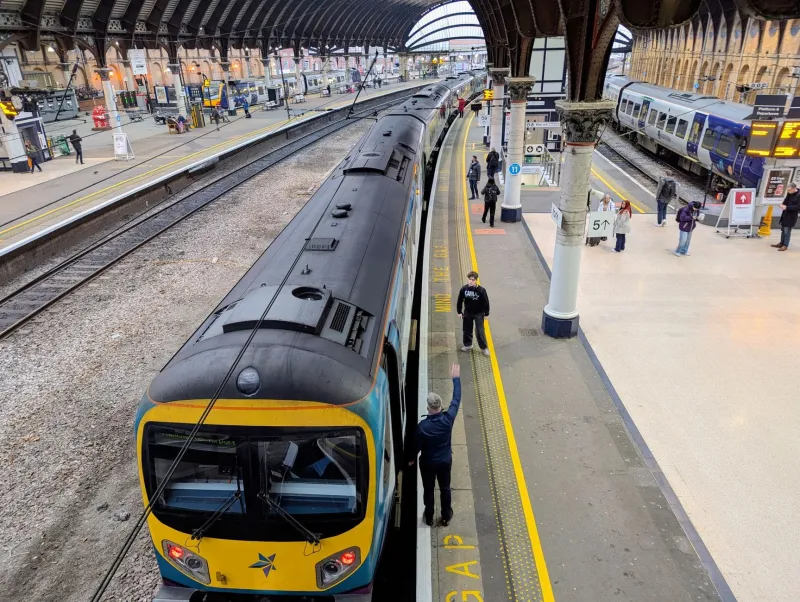
There is a particular silence that follows the words ‘we are sorry to announce’. It is the silence of a hundred people checking their phones, sighing in unison, and quietly recalculating their evening. But on a damp Tuesday in November 2026, at a station in the North West, that silence is broken by something unexpected: a haiku.
‘Cold rails, one leaf falls / the 17:42 is late / the tea is still hot.’
It is not Wordsworth. It is not meant to be. But it does something that a standard delay announcement rarely manages: it makes people look up. A few passengers laugh. One man repeats the line about the tea to his wife. The tannoy, usually a source of ambient irritation, has briefly become a stage.
The 20-Second Form
Station announcing has always been a performance, even when it isn’t trying to be. The clipped urgency of ‘mind the gap’, the weary roll call of cancelled stops, the way a live voice can cut through the pre-recorded hum of a concourse — all of it lands differently when a human being is on the other end. In 2026, a small but noticeable number of those human beings are using their 20 seconds of airtime to do something a little more interesting than apologise.
The form makes sense. A tannoy announcement is not a podcast. You have seconds, not minutes. Passengers are half-listening, already moving, already annoyed. A haiku fits the constraints perfectly: three lines, a handful of syllables, and a truth about the 17:42. Limericks are riskier — too jolly, too long — but they happen. Tiny sonnets are rarer, and usually attempted by announcers who have either too much confidence or a very quiet station.
‘You have to respect the medium,’ says one announcer at a busy northern terminus, who asked not to be named because their employer has not officially sanctioned the poetry. ‘A haiku is a gift. A sonnet is a hostage situation. You can’t hold a platform full of commuters hostage.’
A Haiku in the Waiting Room
It is hard to count exactly how many station announcers are doing this. No one keeps a register. The evidence is scattered across social clips, local news nibs, and the kind of word-of-mouth that travels between rail staff on late shifts. There are announcers in South Wales who write couplets about the weather. There are ones in Scotland who favour a dry one-liner over a full poem. There are ones in the Midlands who have turned the apology itself into a kind of found poetry: ‘We regret to inform you / that the train / regrets to inform you.’
What unites them is not a style but a setting. The platform is a strange literary venue: open-air, acoustically unpredictable, and filled with people who did not buy a ticket to a poetry reading. That is precisely what makes it work. Folk art has always thrived in the gaps between official culture and everyday life — the sign-painter’s flourish, the busker’s setlist, the hand-lettered notice in a chip shop window. The tannoy is another gap. It is a corporate tool being used, briefly and quietly, for something human.
The Rules of the Platform
There are unwritten rules. Don’t overdo it. Don’t make the delay about you. Never rhyme ‘train’ with ‘pain’ unless you are absolutely certain the audience is on your side. And always, always read the room — or rather, the platform. A haiku about the beauty of autumn rain lands differently when people are stranded at 11pm with a dead phone and a lukewarm pasty.
‘The best ones are short and a bit self-aware,’ says a regular commuter at Bristol Temple Meads who has been collecting announcements on her phone for two years. ‘If it’s too whimsical, it feels like the railway is laughing at you. If it’s too bleak, you might as well just say the train is cancelled. The sweet spot is somewhere between sorry and silly.’
That sweet spot is where the accidental poets operate. They are not trying to launch a literary movement. Most of them are just trying to get through a shift. But in doing so, they have stumbled onto something that feels increasingly rare: a live, unpolished, public voice that is not trying to sell anything. The tannoy is one of the last mass mediums where you can reach hundreds of people at once without an algorithm, a thumbnail, or a call to action. It is also one of the last places where you can be genuinely, usefully boring — and then, for ten seconds, not boring at all.
Folk Art With a Timetable
Is the railway platform the last place you would expect to find a thriving folk art scene? Perhaps. But maybe that is the point. Folk art does not announce itself. It turns up in the margins, in the spaces between delays, in the voice that tells you the 18:03 is running late. It is not framed or curated. It is heard once, maybe twice, and then it is gone.
The announcers themselves are modest about it. Most will tell you they are not poets. They are just people with a microphone and a timetable. But listen closely and you can hear the craft: the pause before the punchline, the careful syllable count, the way a silly rhyme can defuse a platform full of frustration. It is not the stuff of anthologies. It is better than that. It is the stuff of a Tuesday evening, a missed connection, and a stranger’s voice making you smile anyway.
Next time your train is delayed, then, keep half an ear on the tannoy. You might get an apology. You might get a haiku. Either way, you will get a small reminder that even the most corporate of spaces can be briefly, unexpectedly human.